


What is a Plantar Wart?
Plantar warts (verrucae plantar) are benign skin lesions usually occur in areas of pressure areas. They are whitish in colour and usually have a rough appearance.
The plantar wart is caused by infection with human papillomavirus (HPV). Benign and common biotypes are VPH1, VPH2 and VPH4. The incubation period can vary between 2-18 months.
Diagnosis of plantar wart
At the clinical diagnosis the following symptoms are observed:
- Painful pinch
- Haemorrhagic stippling (small darker spots inside)
- Bleeding while delaminate with a scalpell
However, for a completely accurate diagnosis, a PCR Test (Polymerase Chain Reaction), which analyses the presence of viral DNA and the sequence thereof, will be made. The specificity of the PCR Test is 99.9%.
The sampling for the PCR is completely painless and the results are available in about 10 days. We recommend this analysis in the case of recalcitrant warts resistant to a conservative treatment.
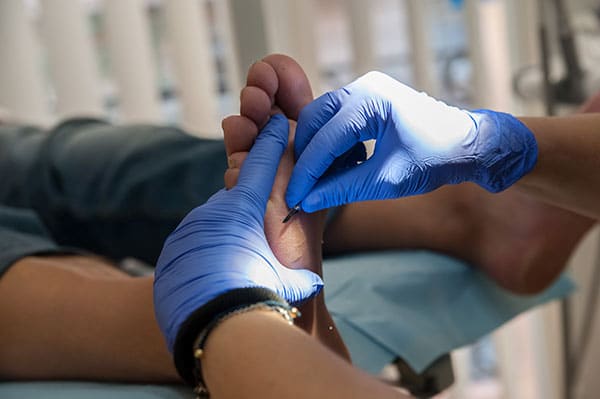
Conservative treatment of plantar warts
Chemical treatment
It consists of the application of chemical compounds such as trichloroacetic acid, monoacetic acid, or cantharidin.
Cantharidin is prepared in a pharmacy office and is dispensed exclusively for each patient.
The treatment time to achieve healing will vary depending on the number of lesions. Usually, for small and simple lesions, a single treatment is performed, and the complete healing will be achieve in 3 to 4 weeks.
All conservative treatments are complemented by a pattern of hygienic measures that the patient must follow at home.
Surgical treatment of plantar warts
This is applied for recurrent warts, with unusual biotypes, at appearance of a multitude of warts or if the first-line conservative treatment failed. There will be a resection of the wart(s) under a local anaesthesia.